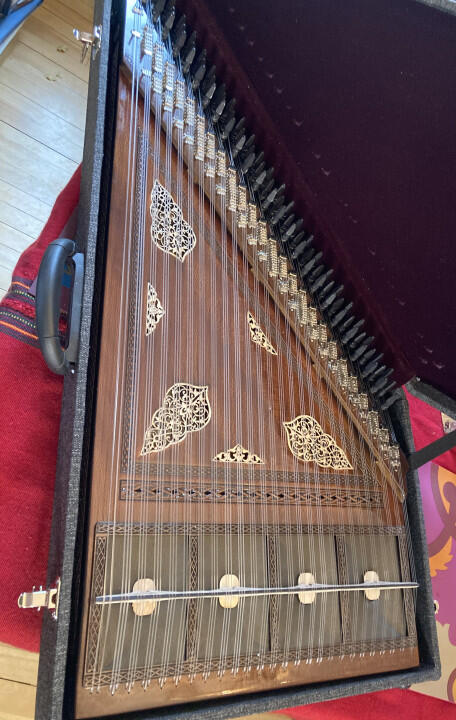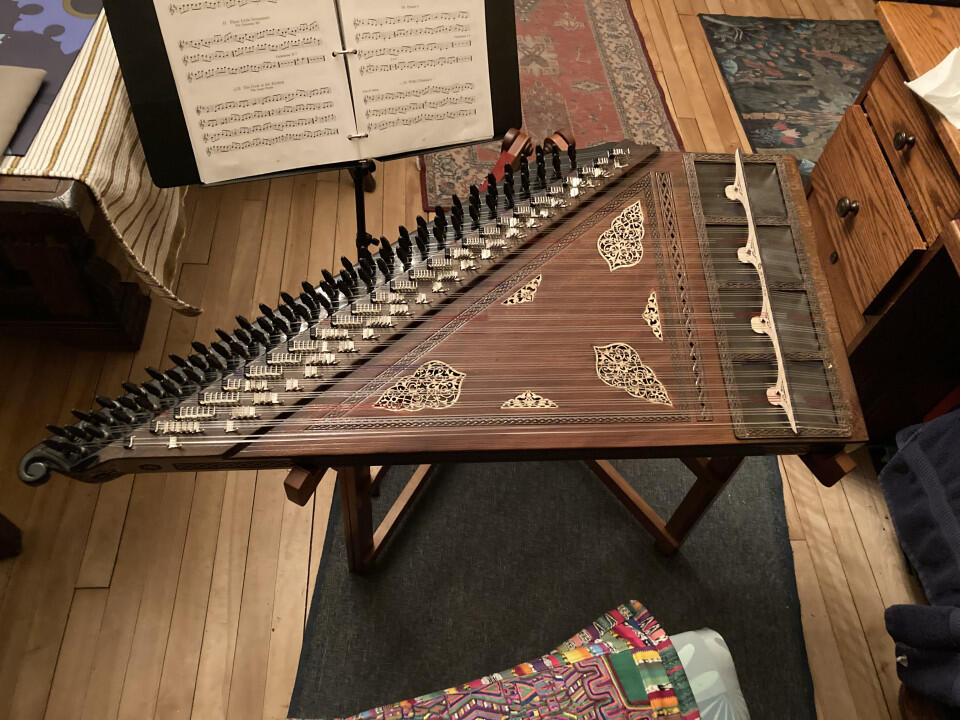
MK-123 由 Mustafa Saglam 在土耳其製作,是一把專業的土耳其卡龍琴,琴身採用法國梧桐木,弦軸為烏木,變音桿為白銅。全琴共有 78 條 PVF 弦,分為 26 組弦組,音域從低音 A(La)到高音 E(Mi)。
若您正在為土耳其音樂挑選卡龍琴,製琴師、弦的排列方式與變音桿系統都是不錯的入手處。MK-123 將這些集於一身,並隨琴附上專業硬盒,以及調音與演奏所需的配件。
MK-123 的 26 組弦組,每一組都由三條調至同一音高的弦構成。變音桿讓您在演奏過程中改變某一弦組的音高,這是演奏土耳其 makam 音樂中各種音程與轉換的重要環節。
無論您是慢慢研讀一首樂曲,或是為演出準備曲目,這樣的配置都讓您有足夠空間同時處理旋律與伴奏。
Mustafa Saglam 以法國梧桐木製作 MK-123,搭配烏木弦軸與白銅變音桿。琴弦為 PVF。
規格表有助於比較不同樂器,但聲音同樣重要。請聆聽本頁的示範,留意旋律的清晰度、低音的反應,以及每一樂句之後琴弦延音的表現。
| 項目 | 內容 |
|---|---|
| 型號 | MK-123 |
| 樂器 | 專業土耳其卡龍琴(qanun / kanun) |
| 製琴師 | Mustafa Saglam |
| 製造國 | 土耳其 |
| 琴身木材 | 法國梧桐木 |
| 弦軸 | 烏木 |
| 變音桿 | 白銅 |
| 琴弦 | PVF |
| 弦數 | 78 |
| 弦的排列 | 26 組弦組,每組三條弦 |
| 音域 | 低音 A(La)至高音 E(Mi) |
您的 MK-123 隨琴附上:
專業硬盒
專業調音鑰匙
專業撥片
專業指環
硬盒可在收納與運送時保護樂器。調音鑰匙、撥片與指環皆已包含在內,您不需要另外添購這些基本配件。
MK-123 由 Mustafa Saglam 在土耳其製作。
qanun 與 kanun 是同一種樂器名稱的不同拼法。各地的形制與調音系統可能有所不同;MK-123 是土耳其型制的樂器。
初學土耳其卡龍琴的學習者與經驗豐富的演奏者都可以使用。如果您正在上課,訂購前請請您的老師確認它的音域與土耳其式配置符合您的課程。
變音桿是用來改變琴弦音高的小型撥桿。它讓演奏者在演奏時調整音程,而不必用調音鑰匙逐條重新調音。
MK-123 共有 78 條弦,分為 26 組弦組。每一組弦組包含三條調至同一音的弦。
是的。專業硬盒、調音鑰匙、撥片與指環皆已包含在內。
收到後、演奏前應先檢查調音。弦樂器在運送與環境變化之後可能需要調整。
可以。請觀看本頁的音色示範。若您對 MK-123 有任何疑問,或希望我們協助判斷它是否適合您演奏的音樂,請在訂購前與 Sala Muzik 聯絡。
我何時會收到訂單?
全球免運配送時間為 3–5 週。
DHL 全球配送時間為 2–4 天。
Sala Muzik 是否提供國際配送?
目前我們配送至全球各地。
Extremely pleased with the quality, the beautiful design and especially the sound of this Kanun. Shipping was timely and well packaged. Was very impressed with how well it stays in tune, even after long practice sessions and with variations in weather. The hard case is very stable, yet quite easy to carry.
My highest compliments and deep gratitude to Sala Music! Teşekkür ederim!
My first Kanun. I don’t have much experience to compare but the more time I spend the more fun I get. Inlays seems to be set strategically and very helpful mapping the instrument. I figured imaginary lines between inlays which makes it easy to locate harmonics. I am not sure whether it was random or ingenious of the maker, but I am leaning towards latter. Had it for a few weeks and tuning hasn’t set in yet. May be this is natural to this instrument since it has many moving organic parts. Once tuned it holds pretty well during fun session. I practice about 3-4 times a week. I need to spend 15-20 minutes each time to tune. It loses a few cents on almost all strings. Sometimes I tune using mandals to get there faster if all three strings lost value to a closer or similar degree. So far I am happy with the purchase. It arrived fast and it was packed very well.
I'm satisfied with the good quality of this beautiful Kanun. I received it in my country after 5 days only from payment and without extra taxes. I never played Turkish Kanun (I used to play on Arabic Kanun) and I think this is a good one in term of quality and price. It's also with lightweight and easy to carry as arabic ones are heavy! Thank you SALA MUZIK :)
This is my first time buying a Kanun and it has a really great sound. Thanks to Mustafa Saglam who created an instrument that gives pleasure when you play and here it. I even received some extra strings for the Kanun. If you are interested in Turkish Makams, Classical Turkish Music and more, you can definitely give this instrument a try! If this is the first time you are seeing this instrument, try listening Goksel Baktagir and Aytac Dogan.
This is a beautiful instrument, and I've been looking forward to learning to play it. I bought it so I could play some microtonal tunings by using the mandals, but that concept only works if the tuning is stable. Due to a combination of peg slippage and the stretching of the new nylon strings, a few strings are out of tune again even before I finish tuning. A friend advised me to put chalk on the pegs that totally came loose during tuning, and I've been doing that. It does help. I don't know whether the tuning will become more stable as the instrument settles down, or whether there's something odd about this particular qanun. Tuning before you play is of course necessary for any qanun! It's what musicians do.As a point of reference, the Korg chromatic tuner is worse than useless with a rapidly decaying plucked string. I'm using a sustained synthesizer tone for reference while tuning, a pure sawtooth wave. I know what strings sound like when they're in tune. I don't mind a little beating between two strings in a course. That adds to the tone quality of the qanun. But what I've heard so far, in the first few days, is more than "a little beating."