
Persian Setar Guide: History, Construction, Tuning & Playing

The Persian setar is a small, long-necked lute with a quiet but remarkably expressive voice. It belongs to the core instrumental tradition of Iranian classical music and is especially suited to intimate solo playing. Its name literally refers to “three strings,” yet the modern instrument normally has four metal strings.
That apparent contradiction tells part of the setar’s history. The fourth string was added later and is commonly associated with the early-19th-century mystic and musician Moshtaq Ali Shah. Players still sometimes call it the “Moshtaq string.” It enriches the drone and resonance without changing the instrument’s historical name.
Persian setar at a glance
| Feature | Typical setar |
|---|---|
| Instrument family | Long-necked, fretted Persian lute |
| Strings | Four metal strings arranged as three playing courses |
| Frets | Movable tied frets, commonly about 25–28 |
| Playing method | Plucked mainly with the nail of the right index finger |
| Body | Small pear-shaped bowl, usually mulberry; one-piece or ribbed |
| Musical setting | Iranian classical music, radif study, solo playing and small ensembles |
Dimensions, fret count, string gauges and tunings vary among makers, schools and players. Treat specifications as a starting point rather than a universal standard.
Construction of the setar

Body and soundboard
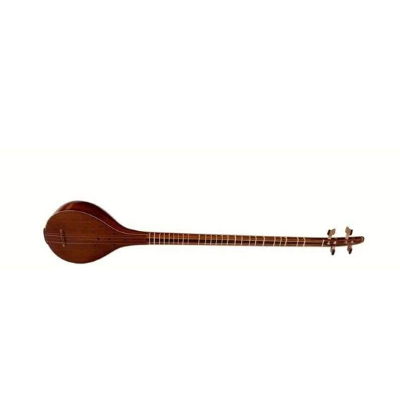
The compact, pear-shaped resonator is traditionally made from mulberry. A one-piece bowl is carved from a solid block; a ribbed bowl is assembled from narrow wooden strips. Neither method is automatically superior. Wood selection, thickness, symmetry, internal volume and the relationship between bowl and soundboard all affect response.
The thin wooden soundboard carries several small sound holes rather than one large central opening. Their size and placement influence air movement and projection. Because the top is light, it should be protected from impact and excessive pressure.
Neck, fingerboard and frets
The long neck is often walnut. Movable frets are tied around it, traditionally with gut and today also with durable synthetic material. Their positions allow the interval shades used in Persian modal music; they are not simply a Western equal-tempered fret layout. The exact number and placement depend on the maker and the player’s needs.
Strings and courses
A modern setar has four metal strings but three functional courses. The two middle strings lie close together and are usually played as a pair. String materials and gauges differ, but steel and bronze-family strings are common. A suitable set should match the instrument’s scale length, intended tuning and structural limits.
How the setar is played

Unlike the tar, which is normally played with a small plectrum, the setar is chiefly plucked with the nail of the right index finger. Alternating inward and outward strokes can produce single notes, rapid repeated strokes, rhythmic patterns and delicate changes of color. The other fingers help stabilize the hand without locking it rigidly to the soundboard.
The left hand uses slides, ornaments, trills, vibrato and subtle changes of pressure. Clean intonation depends on accurate finger placement and correctly positioned frets. A relaxed touch matters: excessive force can sharpen notes, create noise and reduce the instrument’s natural resonance.
Holding the instrument
The small bowl rests lightly against the player’s torso or upper leg, while the neck points slightly upward. The player should not squeeze the bowl. A stable but unforced posture gives the right index finger freedom and keeps the left wrist mobile.
Setar tuning
There is no single tuning for every piece. Iranian musicians retune strings according to the dastgah, avaz, tonal center, teacher and repertoire. A frequently taught reference arrangement is based around C and G, but absolute pitch may be shifted to suit the player or instrument. The paired middle course is generally tuned in unison, while the bass and drone relationships change with the mode.
For practical tuning examples, see our guide to tuning a Persian setar. Always approach the target pitch gradually, especially with unfamiliar strings. If a proposed tuning creates unusually high tension, stop and confirm the correct gauges with a teacher, maker or experienced seller.
Sound and musical character
The setar is known for a focused, transparent and intimate sound rather than sheer volume. Each pluck carries a clear attack followed by a fine, complex resonance. Open strings and sympathetic vibration create a halo around the melody, while changes in nail angle and stroke position can make the tone soft, dry, bright or urgent.
Its limited acoustic power is part of its identity, not a defect. The setar rewards close listening and nuanced control. In an ensemble it needs sensitive balance; on stage, careful microphone placement usually preserves its natural character better than excessive processing.
The setar in Persian classical music
The instrument is closely linked to the radif, the organized body of melodic models that underpins Iranian classical practice. A player learns more than a sequence of notes: phrasing, ornament, modal movement, rhythmic flexibility and the expressive weight of individual tones are transmitted through long study with a teacher.
The setar can present a melody while its open strings supply drones or rhythmic resonance. This makes it effective for exploring the changing tonal centers and emotional contours of the dastgah system. Read our broader guide to Persian music for context.
History and cultural importance

The setar belongs to an old family of long-necked Iranian and Central Asian lutes. Surviving images, texts and related instruments show a long process of development rather than one fixed design preserved unchanged from antiquity. The modern setar took shape through the work of generations of musicians and makers.
Because of its quiet voice, it became associated with private study, contemplation and refined solo expression. It has also held a place in Sufi and mystical contexts, although it should not be reduced to a purely religious instrument. During the 20th century, influential performers and teachers brought it into concert life, broadcasting and formal music education.
How to choose a Persian setar
- Check the neck: it should be stable and comfortable, with no twist that prevents clean action.
- Inspect the frets: knots should be secure, positions usable and spacing appropriate for Persian music.
- Play every note: listen for severe buzzing, dead notes and uneven response.
- Evaluate the action: strings should speak cleanly without excessive left-hand pressure.
- Listen across registers: bass, paired middle course and upper string should feel connected rather than isolated.
- Inspect the bowl and top: look for open seams, cracks, loose parts or distortion around the bridge.
- Confirm the setup: ask which tuning and string gauges the maker or seller recommends.
- Judge sound, not decoration: elaborate ornament does not guarantee better materials, workmanship or tone.
Beginners benefit more from stable tuning, accurate fret placement and comfortable action than from costly decoration. If buying online, request clear photos, measurements, a sound sample and details of the case and setup. You can compare available models in the Sala Muzik setar collection.
Care and maintenance
- Keep the instrument in a supportive case when it is not being played.
- Avoid direct sun, heaters, very dry rooms, excessive humidity and sudden temperature changes.
- Wipe the strings and neck gently after playing.
- Do not move tied frets casually; small changes affect intonation throughout the mode.
- Replace strings with gauges appropriate to the scale and tuning.
- Have cracks, loose ribs, lifting bridges, slipping pegs or persistent buzzing checked by a qualified repairer.
Frequently asked questions
Why is it called setar if it has four strings?
The name refers to its earlier three-string form. A fourth string was added later, but the established name remained.
Is the setar played with a pick?
Traditional setar technique primarily uses the nail of the right index finger. This is a key difference from the Persian tar, which is generally played with a plectrum.
Are the frets made of gut?
Traditional tied frets are gut; many modern instruments use synthetic fret material. The strings themselves are metal.
Is the setar the same as the Indian sitar?
No. Their names share an etymological connection, but their construction, string systems, technique, repertoire and sound are distinct.
Can a beginner learn setar?
Yes. Its light weight and intimate sound are inviting, but right-hand articulation, Persian intonation and radif-based phrasing are best learned with a knowledgeable teacher.
What should come with a setar?
At minimum, confirm the case, suitable strings and the seller’s tuning guidance. For shipping, the neck, bridge and delicate soundboard need secure protection.


Puedes ver los modelos desde este enlace: https://salamuzik.com/collections/setar
Me interesa comprar un setar bien de precio !
Leave a comment