How to Tune a Turkish Long-Neck Bağlama (Saz)
A long-neck bağlama (uzun sap saz) can support several traditional tuning systems, but bozuk düzen—also called kara düzen—is one of the most widely used starting points. Its three string courses are commonly described by the relationship A–D–G (Turkish: La–Re–Sol).
This relationship is more important than copying a single absolute pitch from a video. The entire tuning may be transposed to suit the instrument’s scale length, string gauge, repertoire, singer, or ensemble. If you do not know the intended pitch range of your particular saz, keep close to its existing stable tuning and ask the maker or an experienced teacher before making a large change.
Long-Neck Saz at a Glance
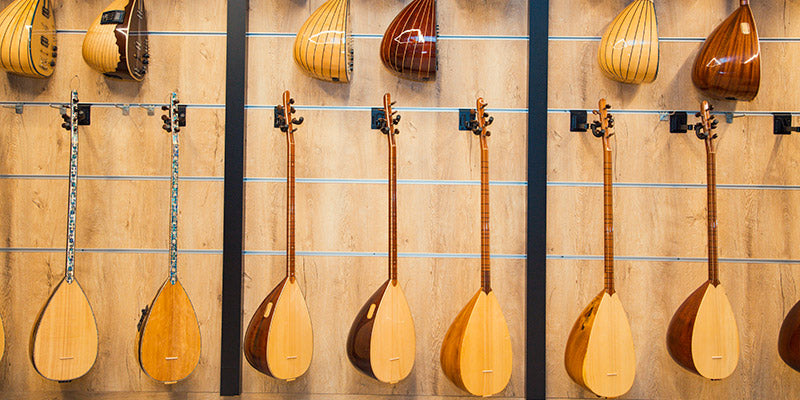
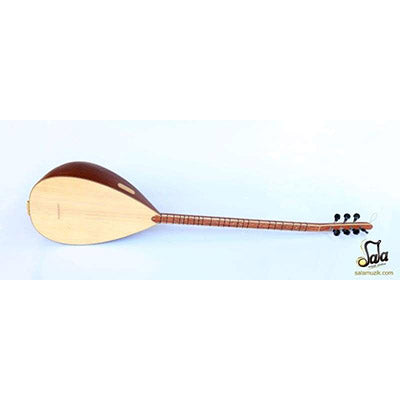
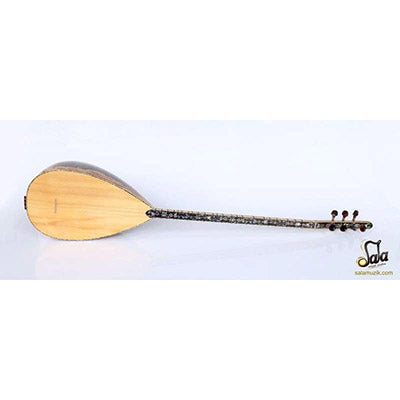
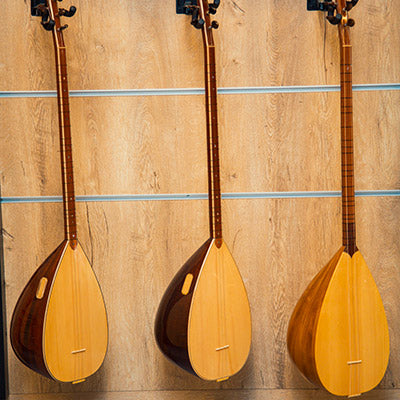
The long-neck bağlama has a bowl-shaped body, a wooden soundboard, a long fretted neck, and usually seven strings arranged in three courses. Instruments and stringing patterns vary, so do not assume that every long-neck saz uses an identical octave arrangement. The movable frets make it possible to perform the microtonal intervals used in Turkish folk music.
Cura, tambura bağlama, and divan sazı belong to the broader saz family but differ in size, register, scale length, and suitable strings. A tuning that is safe on one member of the family may place unsuitable tension on another.
What Is Bozuk or Kara Düzen?
In a common reference form, the three courses follow A–D–G. In Turkish note names this is La–Re–Sol. The word Sol means the note G; translating it as “left” is an error. Likewise, kara düzen is the traditional name of the tuning and should not be rendered literally as “black pattern.”
| Common reference | Turkish name | International note |
|---|---|---|
| First course | La | A |
| Second course | Re | D |
| Third course | Sol | G |
Course labels such as “top,” “bottom,” “upper,” and “lower” are unreliable without a diagram: some teachers mean physical position while others mean pitch. Identify each course on your own instrument and use one consistent convention.
Before You Start
- Use a chromatic clip-on tuner or a reliable chromatic phone app.
- Work in a quiet room and mute strings you are not measuring.
- Confirm that the bridge is upright and in its established position.
- Check that the strings are intended for a long-neck bağlama and are not visibly damaged.
- Set the tuner to A4=440 Hz unless your teacher or ensemble specifies another reference.
How to Tune a Long-Neck Bağlama Step by Step
- Choose the düzen and reference pitch. For bozuk/kara düzen, establish the A–D–G relationship at a safe overall pitch for your saz.
- Trace each string to its peg. Pluck the string and touch it lightly to confirm which peg controls it before turning anything.
- Tune one string in the first course. Pluck gently and approach the target from slightly below with small peg movements.
- Complete that course. Match its other strings according to the installed unison/octave arrangement. A correct note letter in the wrong octave can create excessive tension.
- Tune the second and third courses. Mute neighboring courses so the tuner receives a clean signal.
- Repeat the full cycle. Added tension can pull earlier courses slightly out of tune, so A–D–G must be rechecked.
- Test musically. Play open-course combinations, a drone, and a familiar phrase. Listen for beating between strings that should agree.
Understanding Oktav Arrangement Inside a Course
A seven-string bağlama commonly divides the strings among three courses, but the internal arrangement is not universal. Some strings sound in unison; others may reinforce the course at an octave. A tuner can show the same letter for two different octaves, so watch the octave number if the app provides one and compare the string’s tension with its neighbors.
If a string becomes unusually stiff before reaching the expected reading, stop. Do not keep tightening it in an attempt to match a diagram intended for a different scale length or string set.
Karar Sesi and Transposing the Tuning
Karar sesi is the tonal center or resting note on which a melody resolves. A singer or ensemble may need the whole tuning shifted. Transposition means moving all three courses together while preserving their interval relationship; it does not mean altering only one course at random.
Musicians sometimes name tunings relative to vocal range or local practice. This is why different lessons may show different letters for what is functionally the same düzen. Before changing to a substantially higher pitch, confirm that the string gauge and instrument are designed for it.
Video: Long-Neck Bağlama Tuning
Use the video to follow the course order and technique, but verify its absolute pitch with a tuner rather than matching it blindly by ear.
Troubleshooting
The tuner jumps between notes
Mute the other courses, reduce background noise, pluck more gently, and wait for the initial attack to settle. A clip-on tuner often works better than a phone microphone in a noisy room.
The peg slips back
Apply only gentle inward pressure while turning a traditional friction peg. If it repeatedly slips or sticks, have the peg fit checked rather than forcing it.
Open strings are correct but fretted notes sound wrong
The bridge may have moved, or the fret/bridge setup may need attention. Open-string tuning cannot correct a misplaced bridge or an intonation problem.
One string sounds rough against its partner
The two strings may be slightly apart in pitch, or they may be intended for different octaves. Tune them individually, then listen together for slow beating.

Safety and Maintenance
- Never force a peg or a string that feels abnormally tight.
- Tune up to the note gradually rather than making large turns.
- Recheck after transport, temperature changes, and every string change.
- Expect new strings to stretch and require several small corrections.
- Use the string set recommended for the instrument’s scale length and intended düzen.
Frequently Asked Questions
Is A–D–G the only long-neck saz tuning?
No. It is a common bozuk/kara düzen reference, but other düzenler are used for different regional styles and pieces.
Can a beginner tune by ear?
Ear training is valuable, but a chromatic tuner gives a safer reference while learning course order, octaves, and peg response.
Should beginners always start on a long-neck saz?
Not necessarily. The better choice depends on the repertoire, teacher, hand comfort, and learning goals. A short-neck instrument is not inherently less suitable for a beginner.
How often should a long-neck bağlama be tuned?
Check it before every playing session and after transport or environmental changes. During long rehearsals, quick rechecks are normal.
Related guide: How to Tune a Bağlama: Short-Neck, Long-Neck & Düzen Guide


Hallo,
Ja, Sie können es mit einem Kapodaster als kurzen Griff verwenden. Sie können ein kurzes Hals-Tuning durchführen
Hallo, kann ich aus meiner Langhals Saz auch eine Kurzhals Saz machen, wenn ich einen Kapodaster benutze?
Wie muss ich die Saz dann stimmen ?
hello i have a Cura but i dont know how to tune it could you tell me how please? what are yhe notes from down to up.thanks
Thank you for the article it really interested me.
It was a very informative article. Thank you so much.
Leave a comment