
How to Tune a Turkish Oud: Notes, Order & Safe Steps

A Turkish oud should be tuned for its scale length, strings and intended repertoire—not by copying an unexplained list of notes. The most widely used six-course Turkish setup is written from the lowest-pitched course to the highest as C♯–F♯–B–E–A–D. Read in the opposite direction, from the highest course nearest the floor in normal playing position toward the lowest bass course, the same tuning is D–A–E–B–F♯–C♯.
Stating the direction matters. Many apparent contradictions in oud-tuning charts are simply the same notes listed in reverse order. Other legitimate setups also exist, especially for the two bass courses, but the strings, scale length and teacher’s system must agree before you retune.
Quick reference: standard Turkish oud tuning
| Course | From low to high | From high to low |
|---|---|---|
| 6th / lowest bass | C♯ | — |
| 5th | F♯ | — |
| 4th | B | — |
| 3rd | E | — |
| 2nd | A | — |
| 1st / highest | D | D |
| Complete sequence | C♯–F♯–B–E–A–D | D–A–E–B–F♯–C♯ |
Octave numbers are often omitted because actual register notation varies among tuner apps and written conventions. Match each course to a reliable reference or teacher and listen for the appropriate register; do not pull a bass string up an octave simply because the tuner displays the correct letter name.
Before you tune

- Confirm the instrument: Turkish ouds generally have a shorter scale and are commonly tuned higher than many Arabic ouds.
- Identify the string set: the package should name the intended tuning or tension. Arabic and Turkish sets are not automatically interchangeable.
- Count the courses: a common oud has eleven strings in six courses—five paired courses and one single bass—although twelve-string configurations also exist.
- Check the bridge and strings: make sure loops or knots are secure and that the strings run cleanly through the nut.
- Use a chromatic tuner: choose chromatic mode, disable guitar-only presets and set the calibration to A=440 Hz unless your ensemble or teacher specifies another reference.
- Tune in a quiet room: sympathetic vibration and room noise can confuse a phone microphone.
How to identify the courses
Hold the oud in playing position. The course nearest the floor is normally the highest-pitched D course. Moving upward across the face toward the player, the standard sequence is D, A, E, B, F♯ and finally the lowest C♯ bass. The exact physical orientation can feel reversed when the instrument lies flat, so identify courses by pitch and thickness rather than by a vague phrase such as “top string.”
The five higher courses are usually pairs tuned in unison: both strings in a pair should produce the same pitch. The lowest bass is commonly a single string. Never assume that two neighboring strings form a pair without checking their bridge and peg routing.
Step-by-step tuning method
- Start below the target: if a string’s pitch is uncertain, loosen it gently and approach the note from below. This reduces the risk of overshooting.
- Pluck one string only: damp adjacent courses with the free hand so the tuner reads the intended string.
- Turn the correct peg in small amounts: oud pegs are friction pegs. Apply light inward pressure while turning; never force a stuck peg.
- Watch both note and direction: confirm the letter—including sharp signs—and whether the pitch is flat or sharp.
- Match the partner string: tune the second string of a paired course to the tuner, then check the pair by ear. Pulsing or beating indicates a mismatch.
- Work through all courses: tune gradually rather than bringing one string from very loose to full tension at once.
- Repeat the full pass: changing overall tension can shift courses already tuned. Two or three passes are normal.
- Recheck after playing: new strings stretch, knots settle and pegs may move during the first sessions.
Which direction should I turn the peg?
There is no safe universal answer such as “clockwise tightens.” Peg orientation and string winding can differ. Watch the visible string segment or lightly test the pitch: if it rises, tension is increasing; if it falls, tension is decreasing. Stop immediately if the pitch jumps, the string binds, or the peg feels abnormally resistant.
A slipping peg may need correct seating or professional attention. A dry, jammed or poorly fitted peg should not be forced with pliers. Sudden peg movement can break the string, damage the pegbox or drive the pitch far above its target.
Alternative Turkish oud tunings

Players sometimes alter one or both bass courses to suit a makam, tonal center, composition or ensemble. You may encounter low-to-high arrangements such as D–G–B–E–A–D or other bass variants while the upper four courses remain B–E–A–D. These are real working choices, not a single mandatory “Hicaz tuning.” Makam Hicaz can be performed in different transpositions and does not by itself dictate one universal open-string setup.
Do not move from C♯–F♯ basses to D–G, or to another arrangement, without checking that the string gauges tolerate the new tension. Raising a course by a semitone or whole tone increases load; a set designed for a lower pitch may become stiff or unsafe. Lowering too far can produce poor response and buzzing.
Turkish oud versus Arabic oud tuning
Turkish and Arabic ouds share the same basic family but often differ in scale length, construction, string tension and customary pitch level. A note sequence appropriate for one instrument may place the other under unsuitable tension. The label “oud strings” is not enough: look for the intended scale and tuning on the set.
If you own an Arabic oud, consult a tuning guide and string set specifically for that instrument. Do not raise an Arabic setup to Turkish pitch merely to follow this page unless a qualified maker or teacher has confirmed that the instrument and strings are designed for it.
Using a tuner accurately
- Pluck gently near the middle of the string’s speaking length and wait for the reading to settle.
- Make sure the tuner shows F♯ or C♯ rather than F or C.
- If the display jumps, mute other strings, move closer or use a clip/contact pickup where practical.
- Trust the register and tension as well as the note name; octave errors can break strings.
- Use the tuner for accuracy, then listen to paired courses for beating and tonal balance.
A tuner measures frequency, but it does not know whether you selected the right course, octave, string gauge or regional setup. Those decisions come from the instrument’s specifications and musical context.
Common tuning problems
The tuner shows the right letter, but the string feels too tight
You may be aiming at the wrong octave or using an unsuitable string. Stop tightening and verify the course, string package and reference pitch.
The pitch drops immediately
New strings may be stretching, the bridge knot may be settling, or the peg may be slipping. Retune gradually. If the peg repeatedly releases, have its fit checked.
The paired strings sound rough
Even if both display the same note, a small frequency difference creates beating. Pluck them separately, refine each reading and then compare together.
The tuner cannot detect the bass
Use a stronger but controlled pluck, damp the other strings, try the 12th-fret harmonic area by lightly touching the midpoint if you know the technique, or use a contact tuner. Avoid tuning by an unstable reading.
A string keeps breaking
Check for a sharp nut slot, bridge edge, burr or incorrect winding. Repeated breakage at the same point is usually a setup problem, not bad luck.
Changing strings and stabilizing the tuning
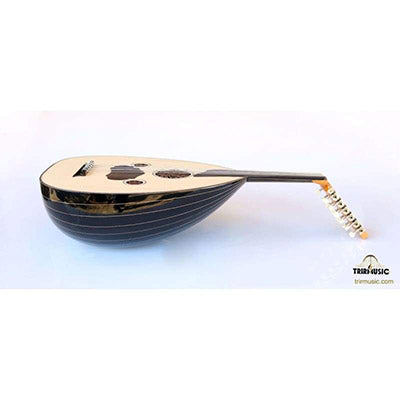
Fresh strings require several tuning passes. Bring them up gradually, stretch them only with gentle playing—not aggressive pulling—and allow knots and windings to settle. Wind neatly toward a position that gives each string a clean path without crossing neighboring strings.
Some players change strings one course at a time to preserve reference and reduce sudden tension changes. If you remove all strings for cleaning or repair, protect the loose bridge if the design is not fixed and document the original routing.
Care after tuning
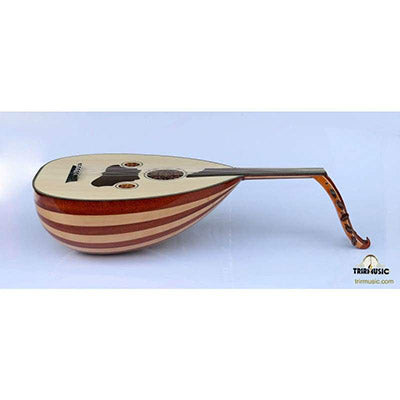
- Store the oud in a supportive case away from heaters, direct sun and rapid humidity changes.
- Wipe strings after playing and inspect winding wear, corrosion and sharp contact points.
- Do not leave the instrument in a hot vehicle; heat changes wood, glue, strings and peg fit.
- Use only string sets suitable for the oud’s scale and target tuning.
- Ask a qualified repairer about persistent peg slippage, nut binding, lifting bridge, cracks or abnormal neck movement.
You can compare suitable instruments and ask about their intended setup through the Sala Muzik Turkish oud selection. When ordering strings, provide the oud’s scale length, number of strings and desired low-to-high tuning.
Frequently asked questions
What is the standard Turkish oud tuning?
A widely used six-course setup is C♯–F♯–B–E–A–D from lowest to highest. The identical setup read from highest to lowest is D–A–E–B–F♯–C♯.
Why do some charts list the notes backward?
Some begin with the lowest bass course; others begin with the highest course. Always look for a stated direction before concluding that two charts disagree.
Are both strings in a course tuned alike?
In the common Turkish setup, paired strings are normally tuned in unison. The lowest bass course is often single.
Must I retune for Makam Hicaz?
No. Hicaz can be played in standard tuning. Some musicians choose alternate bass notes for a particular tonal center or fingering, but there is no single compulsory Hicaz tuning.
Can I use guitar strings?
Not as a general substitute. Oud courses require suitable materials, lengths and tensions. Use a set designed for the instrument and target tuning.
How often should I tune?
Check before every session and again after the instrument warms to the room. New strings and changing humidity usually require more frequent adjustment.


Hi Kenneth,
Yes, it is possible to do F F tuning on a Turkish oud, if you replace strings with F F strings you can use F F tuning
Please check this string set: https://salamuzik.com/products/special-strings-for-arabic-f-f-oud-deep-f
Thank you
Veysel
@Walt Poor: You can use some chalk. Just put a little bit on the spot, where the peg touches the wood, turning in the peghole. This will prevent it from sliding to much. Start with a little bit and use more if needed. If it gets stuck too hard, you can rub the chalk off with a soft towel and use some candlewax instead. The wax will make it slide better. Depending on thime of the year, roomtemperature and humidity levels in your home you will need more or less of one or the other. I hope this works for you :-)
Is it possible to do Fa to fa tuning on a Turkish Oud?
I eould like to get a fill range of these oud video lessons dpoken in Turkish with English subtitles please. I have just started to teach myself Oud snd know some Turidh lNguage. I need to study the videos slowly o er and again
My son has an oud. In principle he knows how to tune it, similar to tuning his other string instruments. However, the pegs won’t stay put in their sockets (if that is what they are called). :Very soon after he tunes a string, the peg turns, and the string goes flat. Solution?
Leave a comment