
5 Influential Baglama (Saz) Artists: A Listening Guide
The bağlama—often called saz outside Türkiye—is central to Anatolian folk music, the âşık tradition, and many modern Turkish styles. A list of the “best” players can never be definitive: regional schools, performance settings, and artistic goals differ. The five musicians below are included because each changed how listeners understand the instrument, whether through folk poetry, radio, composition, education, technical innovation, or popular music.
This guide introduces Neşet Ertaş, Arif Sağ, Orhan Gencebay, Erkan Oğur, and Âşık Veysel. It also explains what to listen for in their work and where a new listener might begin.
Bağlama, saz, and the âşık tradition
Bağlama usually names a family of long-necked lutes with related sizes, tunings, and playing techniques. Saz is a broader Turkish and Persian word for a musical instrument, although it is often used internationally as a synonym for bağlama. The exact instrument, string arrangement, tuning, and plectrum or finger technique can vary by region and performer.
The bağlama is closely associated with the âşık: a singer-poet who performs verse, stories, social commentary, and personal reflection, commonly while accompanying the voice on saz. The tradition is living and diverse rather than a single unchanging style.
1. Neşet Ertaş

Neşet Ertaş (1938–2012) grew up in the musical culture of Central Anatolia. His father, Muharrem Ertaş, was an important folk musician, and Neşet learned the repertory and performance practices heard at gatherings and weddings. He later built a recording and concert career while remaining strongly connected to the songs, dance tunes, and poetic language of his home region.
His singing and bağlama playing are often described as inseparable. The instrumental line does more than supply chords: it answers the voice, shapes the rhythm, and intensifies the meaning of a phrase. His repertory includes traditional material as well as songs identified with his own words and music.
What to listen for
- The close dialogue between vocal ornament and bağlama phrasing.
- Flexible timing that follows the emotional weight of the text.
- A direct, unpolished intensity rather than decorative virtuosity for its own sake.
2. Arif Sağ

Arif Sağ, born in 1945, is a performer, composer, educator, and one of the major figures in the modern presentation of Turkish folk music. His work in broadcasting, recording, concerts, and music education helped bring bağlama repertory to large audiences while encouraging systematic study of technique.
Sağ’s playing combines detailed knowledge of regional material with a clear concert style. His influence is also pedagogical: generations of students encountered bağlama through his teaching, arrangements, and collaborations.
What to listen for
- Clear articulation and carefully shaped ornaments.
- Arrangements that retain folk-music character while using a concert format.
- How the instrument can move between accompaniment, ensemble texture, and solo statement.
3. Orhan Gencebay

Orhan Gencebay, born in 1944, is a singer, composer, arranger, actor, and highly distinctive saz player. He brought the instrument into richly arranged popular recordings that draw from Turkish folk and art music alongside other contemporary influences.
Although his music is frequently placed under the label arabesk, Gencebay has treated that term as too narrow for his musical language. For bağlama listeners, his importance lies in the way he expanded the instrument’s technical and expressive role inside the recording studio. Fast passages, bends, ornaments, and dramatic phrasing become part of a larger orchestral design.
What to listen for
- Virtuosic lines that function as hooks, introductions, and responses to the singer.
- Strong dynamic contrast and dramatic phrasing.
- The integration of saz with strings, percussion, and studio arrangements.
4. Erkan Oğur

Erkan Oğur, born in 1954, is a multi-instrumentalist, composer, and improviser known for connecting Anatolian musical language with new instrumental possibilities. He plays bağlama as well as kopuz, guitar, and other string instruments, and is widely associated with the development of the fretless classical guitar in the 1970s.
Removing the guitar’s frets allowed him to approach pitches and melodic inflections that fixed equal-tempered frets cannot reproduce in the same way. His bağlama work is equally valuable: spacious phrasing, attention to tone, and deep listening often matter more than sheer speed.
What to listen for
- Fine pitch inflection and the expressive space between notes.
- Quiet dynamics, resonance, and carefully placed silence.
- Improvisation that connects traditional melodic thinking with an individual contemporary voice.
5. Âşık Veysel
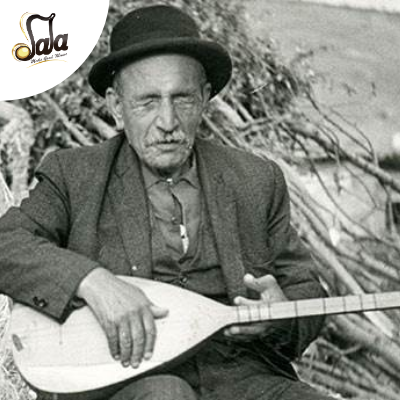
Âşık Veysel Şatıroğlu (1894–1973) was a poet, singer, and saz player from Sivas. He lost his sight in childhood after contracting smallpox and developed a lifelong relationship with the bağlama. His poems address love, mortality, nature, social unity, the homeland, and the human journey in language that is accessible yet layered.
His significance is not based on instrumental display alone. Voice, poetry, and saz form one statement: repeated figures support the meter, brief responses underline a line, and the instrument leaves room for words. Songs such as “Uzun İnce Bir Yoldayım” continue to be interpreted by musicians in many styles.
What to listen for
- Economical accompaniment that keeps the poem at the center.
- Memorable melodic shapes built from repetition and subtle variation.
- The unity of spoken language, sung rhythm, and instrumental pulse.
How to explore these artists
Begin with several recordings by each musician rather than one viral clip. Compare a solo or intimate performance with a studio arrangement. Listen first to the overall expression, then return for the relationship between voice and instrument, tuning, right-hand pattern, ornaments, and use of silence.
No five-person list can represent the full bağlama world. Regional masters, women performers, contemporary innovators, ensemble musicians, and many locally influential teachers deserve separate study. Treat these names as entry points, not a final ranking.
Choosing a bağlama for this repertory
Before buying, consider the music you want to learn, the tuning used by your teacher, scale length, body size, string setup, action, fret placement, and access to maintenance. A more expensive instrument is not automatically the right one for a beginner; comfortable setup and stable construction matter more.
Explore long-neck and short-neck options in the Sala Muzik bağlama collection, and confirm the setup required for your preferred repertory before ordering.
Frequently asked questions
Are saz and bağlama the same instrument?
In international usage they often refer to the same long-necked lute. Strictly speaking, saz can mean an instrument more generally, while bağlama names a particular instrument family.
Who is the greatest bağlama player?
There is no objective answer. A listener may value regional authenticity, poetic accompaniment, technical range, composition, improvisation, or innovation differently.
Is Âşık Veysel known mainly as a player or a poet?
Both roles belong together, but his enduring reputation rests especially on his poetry and the unity of words, voice, and saz.
Which artist is a useful starting point?
Try Âşık Veysel for the singer-poet tradition, Neşet Ertaş for voice–instrument dialogue, Arif Sağ for concert folk style, Orhan Gencebay for popular studio arranging, and Erkan Oğur for timbre and improvisation.


Leave a comment