
Persian Music Guide: Radif, Dastgah, Instruments & Listening
Persian classical music is built from memory, melody, poetry and the creative decisions of the performer. Its central teaching repertory, the radif, organizes hundreds of short melodic models called gusheh within modal families known as dastgah and avaz. Musicians study this material closely, then learn how to shape it through ornamentation, timing, modulation and improvisation.
This guide introduces that system without reducing Persian music to a Western scale chart or treating every Iranian tradition as the same. It also explains characteristic vocal techniques, rhythm, major instruments, learning practice and what to listen for.

What Does “Persian Music” Include?
Persian music commonly refers to musical traditions associated with Persian language and culture; Iranian music can be the broader geographical term. Iran is multilingual and culturally diverse, with Azerbaijani, Kurdish, Luri, Gilaki, Mazandarani, Baluchi, Arab, Turkmen and other traditions alongside Persian classical music. Each has its own repertories, instruments and performance settings.
This article focuses primarily on Persian classical music, sometimes called Iranian classical or traditional art music. Its present-day practice reflects long historical exchange across West and Central Asia, the Caucasus and neighbouring regions. Persian, Arabic and Turkish musical cultures influenced one another; simple one-way claims that one supplied nearly all terminology or instrument prototypes to the others are not historically responsible.
Radif, Dastgah, Avaz and Gusheh
Radif is a canonical teaching repertory transmitted in different versions by particular masters and lineages. It is not a single fixed composition. An instrumental radif and a vocal radif may organize or phrase material differently, and named radifs associated with musicians such as Mirza Abdollah, Aqa Hossein-Qoli or Mahmoud Karimi are not identical.
A dastgah is more than a scale. It is a modal system and performance pathway with characteristic pitch relationships, melodic behaviour, important tones and routes through a family of gushehs. A gusheh is a named melodic model or piece within the radif. Its function may be introductory, developmental, modulatory, rhythmic or cadential.
Seven dastgah and five avaz
A common modern account distinguishes seven principal dastgah: Shur, Mahur, Homayun, Segah, Chahargah, Nava and Rast-Panjgah. Five related branches, generally treated as avaz and linked especially to Shur or Homayun, are Abu Ata, Bayat-e Tork, Afshari, Dashti and Bayat-e Esfahan. People sometimes call all twelve “dastgahs” informally, but the seven-plus-five distinction is more precise.
Daramad and the course of a performance
A performance often establishes the modal identity through one or more daramad sections before moving through selected gushehs. The musician does not normally perform every item in the radif. Instead, the choice and order create an individual route, with changes of register, emphasis, rhythm and modal colour before returning or closing.
Pitch, Intervals and Intonation

Persian classical intonation cannot be described accurately as Western major and minor scales plus fixed “quarter tones.” Some intervals are narrower or wider than the nearest equal-tempered piano interval, but their exact realization depends on the dastgah, melodic direction, phrase, instrument, performer and school.
Modern notation may use the accidentals koron and sori to indicate pitches lowered or raised from a notated reference. These signs are practical aids, not proof that every pitch lies on an equal 24-part division of the octave. Listening and imitation remain essential.
Why a scale alone is not enough
A list of pitches does not show which tone functions as a point of repose, which receives emphasis, how phrases approach a cadence or when modulation becomes meaningful. The identity of a dastgah emerges through melodic movement and remembered models, not from interval measurements alone.
Rhythm, Meter and Free Time
Persian classical performance moves between measured and non-metric or flexibly timed passages. A free-rhythm opening may foreground poetry, melodic contour and ornamentation; a composed tasnif or instrumental reng uses a clearer pulse. A chaharmezrab is typically a fast, metrical instrumental form or passage that displays rhythmic articulation and technique.
The tombak player does more than keep time. In measured sections, the percussionist shapes phrases, responds to accents and supports transitions. In free-rhythm sections, percussion may be absent. Avoid calling Persian musical structure “harmonic” in the Western functional sense: melody, modal development and rhythm are more useful starting points.
Improvisation, Composition and Memory
Improvisation in Persian classical music is not arbitrary invention. It grows from long familiarity with the radif, poetic meter, instrumental technique and stylistic conventions. A performer recombines, extends and connects learned material while responding to the moment.
Composed forms also matter. Tasnifs, rengs, pishdaramads and contemporary works coexist with improvised or semi-improvised passages. The balance changes by artist, program and historical period.
Voice, Poetry and Tahrir

The voice holds a central place in Persian classical music. Poetry by figures such as Hafez, Saadi, Rumi and other poets provides language, imagery and meter for performance. Singers must balance intelligible text with melodic expansion.
Tahrir is a family of rapid, controlled vocal ornaments that can involve repeated notes, register shifts and non-lexical syllables. It is sometimes compared loosely with yodeling, but it belongs to its own aesthetic and technical tradition. Different singers use tahrir with distinct articulation, density and expressive purpose.
Religious and regional vocal practices
Iran also contains many devotional, mourning, Sufi and regional vocal traditions. Terms such as zekr or nowheh/noheh refer to specific practices and should not be treated as interchangeable examples of Persian classical singing. Their texts, functions and community settings differ.
Core Instruments of Persian Classical Music

- Tar: a fretted, long-necked lute with a double-bowl body and a skin-covered sound table.
- Setar: a smaller long-necked lute, now generally with four strings, played with the fingernail.
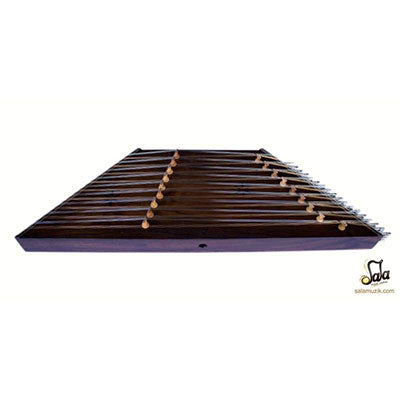
- Santur: a trapezoidal hammered dulcimer whose courses of strings are struck with light wooden mezrabs.
- Kamancheh: a bowed spike fiddle with a rounded resonating body.
- Ney: an end-blown reed flute; Persian technique uses the mouth and teeth in a distinctive way to direct the airstream.
- Tombak: a wooden goblet drum with an extensive finger vocabulary.
- Daf: a large frame drum strongly present in Kurdish and devotional traditions and also heard in contemporary Persian ensembles.
Modern ensembles may also include violin, qanun or other instruments, but that does not make every one of them equally central to the historical core of the Persian classical ensemble.
Tar and setar

Tar offers a powerful, articulated sound and accommodates subtle pitch inflection through movable tied frets. Setar is quieter and more intimate; fingernail technique supports delicate attacks and resonance. Explore our detailed Persian setar guide.
Santur and kamancheh

Santur requires careful control of rebound, damping and balance across multiple string courses. Kamancheh can sustain and inflect tones continuously, making bow pressure, contact point and ornamentation central to its voice.
How Persian Classical Music Is Learned
Radif has traditionally been transmitted through close study with a teacher, using listening, repetition, memorization and imitation. Notation and recordings are valuable, but they do not fully capture intonation, timing, touch or the logic connecting one gusheh to another.
- Develop a reliable tone and relaxed technique on the instrument or voice.
- Memorize short phrases and complete gushehs accurately.
- Learn their place and function within a dastgah or avaz.
- Study poetry, rhythm and characteristic ornamentation.
- Compare respected lineages and recordings rather than treating one version as universal.
- Begin improvising within clear stylistic limits before attempting extended performances.
How to Listen to Persian Music
- Opening: how does the musician establish the modal space?
- Important tones: where do phrases pause, settle or intensify?
- Ornamentation: do decorations clarify the phrase or merely add density?
- Modulation: when does the melodic colour shift, and how is the change prepared?
- Poetry: how do words, meter and meaning influence timing?
- Dialogue: how do voice, melody instrument and tombak respond to one another?
Start with a full performance rather than isolated virtuoso clips. Repeated listening makes the return of melodic ideas and changes of modal colour easier to recognize.
Choosing a Persian Instrument
Choose according to the instrument you genuinely want to study and the teaching available to you. Ask about tuning range, fret placement, bridge alignment, skin or string condition, climate sensitivity, spare strings and maintenance. For santur, verify the instrument’s tuning system and whether suitable strings and mezrabs are available. For tar or setar, comfortable neck geometry and accurately placed frets are essential.
Explore Sala Muzik’s Persian instruments, including santurs, tars and kamanchehs.
Frequently Asked Questions
Are there twelve dastgah in Persian music?
A common modern classification has seven principal dastgah and five related avaz. All twelve may be called dastgahs informally, but the seven-plus-five distinction is more exact.
Is dastgah the same as makam or maqam?
They are related modal concepts from neighbouring musical worlds, but they are not interchangeable. Dastgah includes repertorial pathways and a relationship to the radif and gushehs that should be understood on its own terms.
Does Persian music use quarter tones?
Some pitches fall between equal-tempered piano notes, but “quarter tone” is only a rough shorthand. Intonation changes with modal context, direction, phrase and performer.
What is the radif?
Radif is the canonical repertory of named melodic models transmitted in different versions by masters and lineages. It is both teaching material and a foundation for creative performance.
What is a good first Persian instrument?
The best choice depends on your teacher, preferred sound and physical comfort. Setar can suit intimate solo study, tombak gives direct access to rhythm, and santur, tar, kamancheh or ney each require distinct setup and technique.


I discovered Kayhan Kalhor and absolutely love him! So I’m here to discover more.
אני כותבת עבודה סמינריונית לתואר שני באוניברסיטה הפתוחה בנושא המוסיקה הקלאסית הפרסית. אשמח לראיין נגנים או זמרים בתחום זה.
תודה רבה
אני מחפש תווים למוסיקה פרסית לכינור
Leave a comment