
How to Tune a Persian Setar: Strings, Notes and Safe Steps
A Persian setar must be tuned for the dastgah, avaz or piece being played; it does not have one universal tuning for every repertoire. A common beginner reference is built around C and G, but the bass and Moshtaq drone strings may change according to the mode. Tune slowly, identify each string before turning a peg and use a teacher’s target pitches whenever possible.
Important: the Persian setar is not the Indian sitar and is not the six-string Persian tar. Modern setars normally have four metal strings arranged as three functional courses: two main melody strings, a Moshtaq drone string and a bass string.
Setar tuning at a glance
| String | Common name | Typical role | Frequent beginner reference |
|---|---|---|---|
| 1, nearest the floor in common playing position | White string | Main melody string | C |
| 2 | Yellow string | Second melody string | G below the white string |
| 3 | Moshtaq string | Drone/resonance; often paired in function with the bass | Often C, but mode-dependent |
| 4 | Bam or bass string | Low drone and bass support | Often low C, but mode-dependent |
This produces a common C–G–C–C relationship when stated from the white string toward the bass side, with the final C in a lower register. Some sources list strings in the opposite physical direction, so always confirm both string name and pitch rather than copying a bare sequence. Octave-number labels can also differ between tuning apps and notation conventions.
What is a Persian setar?
The setar is a long-necked Iranian lute with a small, usually mulberry soundbox, a wooden face, movable tied frets and four metal strings. Its name literally refers to “three strings,” reflecting an earlier form. A fourth string associated with the musician and mystic Moshtaq Ali Shah was added later and is commonly called the Moshtaq string.
The instrument is central to Persian classical music and is used for solo playing, vocal accompaniment and study of the radif. It is plucked primarily with the nail of the right index finger rather than with a conventional plectrum.

For construction, history and playing context, read our complete Persian setar guide.
Before you tune
- Use a chromatic tuner or app that can show C, G and altered pitches required by your teacher.
- Tune in a quiet room and mute the strings you are not checking.
- Confirm which peg controls each string before applying tension.
- Inspect the string path across nut and bridge; a string caught in the wrong groove can tune unpredictably.
- If the instrument is new, cold or recently restrung, allow time for wood and strings to settle.
- Do not move tied frets merely to tune the open strings.
Fresh strings stretch and peg friction can change after each adjustment. Expect several gentle passes rather than one large correction.
Identify the four strings
White melody string
The thin white or steel string is the principal melody string. In a common C-based setup it is tuned to C and provides the reference for checking many fingered notes.
Yellow melody string
The yellow or brass string is commonly tuned a fourth below the white string, often G when the white string is C. It supplies contrast in color and supports melodic movement.
Moshtaq string
The third string was added to the older three-string instrument and is used largely for resonance and drone. Its target varies with the chosen dastgah or piece. In a basic C setup it is often tuned to C, commonly in relation to the bass course.
Bam string
The wound bass string provides the low foundation. Low C is a frequent teaching reference, but teachers may choose another pitch to suit the modal center. Do not assume the bass and Moshtaq strings remain the same for every dastgah.
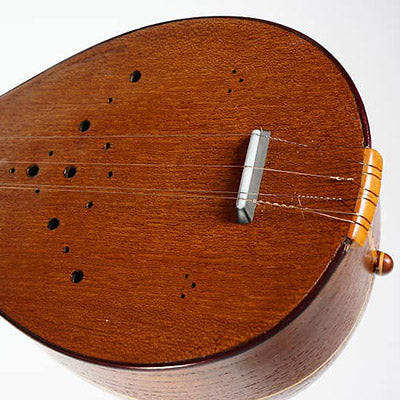
How to tune a setar step by step
- Choose the target tuning. For a first C-based setup, prepare C for the white string, G for the yellow, C for Moshtaq and a lower C for bam. If learning a piece, use the teacher’s exact alternative.
- Start with the white string. Pluck gently, let the tuner settle and turn its peg in very small movements.
- Tune the yellow string. Bring it to G below the white C, checking the open fourth by ear after the tuner reading.
- Set the bass string. Approach the low C gradually. A wound string responds more slowly and may bind at the nut.
- Tune the Moshtaq string. For the reference setup, match its intended C relationship to the bass and melody strings without forcing it into the wrong octave.
- Repeat the cycle. Changing one string changes load on the neck and bridge, so check all four again.
- Test musically. Play open-string combinations, a familiar phrase and the modal resting tone rather than trusting only the display.
How to turn friction pegs safely
Traditional setar pegs work by friction. Support the neck near the pegbox, pluck with the other hand and turn only a little at a time. A slight inward pressure can help a properly fitted peg seat, but excessive force can split the pegbox or break a string.
- If the pitch is far too high, loosen first and approach the note from below.
- Never jump quickly to a target pitch with a new or unidentified string.
- If a peg slips repeatedly, do not compensate by forcing it deeper; have the fit checked.
- If a peg sticks, stop before twisting the head or string. Humidity, poor fit or residue may need professional attention.
- Keep face and eyes away from the string’s path while increasing tension.
Alternative tunings for Persian modes
The melody strings often retain a stable interval while the drone and bass are adapted to the tonal center and important notes of the dastgah or avaz. Tunings encountered in teaching may use different relationships for Shur, Mahur, Homayun, Segah, Chahargah, Nava or specific compositions.
These systems include pitches such as koron that a basic Western tuner may label poorly. A teacher may provide a reference recording, cents offset or a note matched by ear. Do not move the frets to make an open string display a conventional Western note; string tuning and fret placement are separate tasks.
| Situation | Best approach | Why |
|---|---|---|
| First lesson or general technique | Use the teacher’s C-based reference | Creates a repeatable starting point |
| New dastgah or avaz | Confirm bass and Moshtaq pitches before practice | Drones must support the modal center |
| Playing with voice | Transpose only with teacher-approved string tension | Matches vocal range without overstressing strings |
| Playing with an ensemble | Agree on reference pitch and temperament first | Prevents correct relative tuning at the wrong overall pitch |
Fine tuning by ear
An electronic tuner establishes a reference, but setar tuning should also be checked through resonance. Play the white and yellow strings separately, then together. Listen for a stable interval rather than a wavering beat. Compare Moshtaq and bam with their intended octave or unison relationships and with the modal resting note.
Pressing too hard behind a fret can sharpen a note. When checking stopped notes, use normal playing pressure and pluck at normal performance strength.
Common tuning problems
| Problem | Likely cause | What to do |
|---|---|---|
| Peg slips after tuning | Poor peg fit, insufficient seating or changing humidity | Retune gently; if recurring, ask a technician to fit the peg |
| Pitch jumps while turning | String binds in the nut groove | Release tension and have the groove inspected; do not add random lubricant |
| New string continually goes flat | Normal stretching or loose winding | Stretch through playing and retune in several passes |
| Open strings tune but fretted notes disagree | Fret position, finger pressure or bridge placement | Check technique and ask a teacher before moving frets or bridge |
| String buzzes after tuning | Too little tension, damaged string, groove or setup issue | Confirm correct octave and string type; stop if buzzing persists |
When to stop and ask for help
Stop tuning if the string is already tight but the tuner still shows a much lower note, the pegbox creaks, a peg will not hold, the bridge moves or the string is frayed. The wrong octave, wrong string gauge or incorrect winding can damage the instrument. A setar teacher or experienced repairer can identify the issue safely.
Browse available Persian setars or contact Sala Muzik for guidance on string sets, replacement parts and the tuning range of a specific instrument.
Frequently asked questions
What is the standard setar tuning?
There is no single tuning for all Persian repertoire. C–G–C–low C, read from the white melody string toward the bass, is a common beginner reference. Bass and Moshtaq pitches often change for the mode or piece.
Which string is the Moshtaq string?
It is the additional drone string introduced after the setar’s older three-string form. On the modern four-string instrument it sits between a melody string and the bass side, though numbering conventions may run in opposite directions.
Can I use a guitar tuner?
A chromatic guitar tuner or app can set basic C and G references if it detects the setar clearly. For koron pitches and modal adjustments, use a teacher’s reference or a tuner that displays cents accurately.
Should I tune to 440 Hz?
Only when your teacher, recording or ensemble uses A4 = 440 Hz. Persian musicians may choose a different overall reference for voice, instrument tension or ensemble practice. Agree on the reference before tuning.
Why does my setar go out of tune quickly?
New strings, friction pegs, temperature, humidity and changes in bridge or string seating all affect stability. Several gentle tuning passes are normal; persistent slipping or sudden pitch jumps need inspection.


How to tune oud arabic . I need it ( The vidéo)
Leave a comment